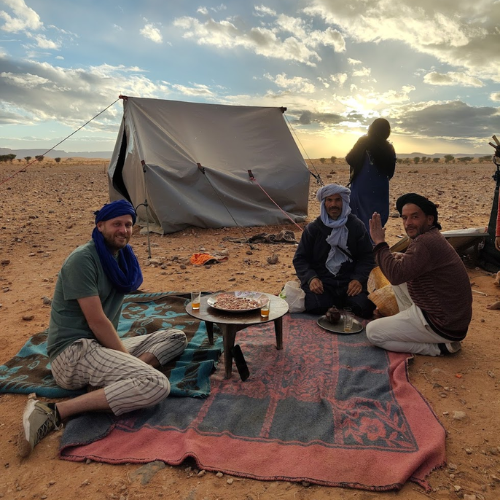
With an electric campervan to Morocco: an amazing adventure

For about five years, Tim (Co-Founder of Outbase) had been thinking about traveling to Morocco by campervan. Whenever he came across beautiful places online, he would save them in Google Maps with the intention: one day, I’ll go there.

That moment came in the winter of 2025/2026. “Not too hot, good waves for surfing, and a great atmosphere among people spending the winter there,” Tim says. When he started driving his own Outbase ID. Buzz, the plan became concrete. “I thought: now is the time. Although I did have my doubts. Taking five weeks off, charging in Morocco… it was definitely exciting.” But instead of focusing on the limitations, he wanted to find out whether it was possible.

In a straight line to the south

Tim drove straight to Marseille, because Morocco was the goal, not the road leading up to it. According to him, the idea that you can’t just “push straight south” with an electric camper simply isn’t true. Charging along the French highways was easy and quick. The ferry crossing, however, took forty hours, and that’s when he realized he might have been a little underprepared…

Help is always nearby

Especially along the route toward the Sahara, there were said to be very few charging points. “Luckily, I quickly discovered that I only needed three apps: one to find all the charging stations, and two others to pay. There were also more charging stations than I expected, and charging at campsites was often possible as well.”

“I was completely unprepared. I didn’t even know which charging cards I needed.”

Lovely campsites

Tim enjoys wild camping, but in Morocco it wasn’t necessary. “Campsites are spacious, very simple, and often beautifully located. A small field, electricity, and a toilet, that’s all I needed.” Campsite owners were remarkably helpful. Sometimes they didn’t even want to charge extra for electricity. “I didn’t feel right about that, so I always made sure to pay something.”

Tim had a rough plan, but mostly just did what he felt like. Once, he skipped a mountain village because he wasn’t sure how long the climb would take. “I just didn’t feel like taking that risk at that moment.”


“My energy consumption was low because I drove calmly, but I wasn’t overly cautious. I turned on the heating when it was cold and the air conditioning when it was warm.”

In the mountains, the ID. Buzz really came into its own. It climbed quietly, powerfully, and surprisingly fast, then regenerated energy on the way back down. “You do have to be careful, though. Children don’t hear you coming." The reactions were heartwarming. People shouted “spaceship,” gave a thumbs-up, and wanted to take pictures. Sometimes they would call a family member who spoke a bit of English, and he would be thanked for coming all the way to their village. A few times, Tim gave someone a lift for part of the journey. “They found the silent driving so strange! Super friendly people.”

A little nerve-wracking at times, but there was always a solution.

On the way back, Tim ran into some trouble. He had to catch the ferry and one charging station wasn’t working, and the campsites were full as well. “The next charger was just out of range. That definitely made me nervous for a moment.” After a night’s sleep at the beach, the same charging station was thankfully working again the next day. “Apparently, that happens more often, I heard afterwards.”


Energy consumption

→ Tim’s average energy consumption in Marocco was 16.2 kWh per 100 km (including heating and air conditioning).

→ His average range was 490 km on a full battery.

→ Tim’s total energy consumption was 510 kWh.

Not a one-time trip

Looking back, there are a few things he would do differently. For example, taking the ferry from Sète to Nador, where customs procedures are said to be faster. And booking an open ferry ticket for more flexibility on the return journey. But one thing is certain: he’s going back. “Next time, I want to head further south, less along the coast. I feel confident enough to do that now. And who knows, I might even join an EV rally to Dakar!”


“I always thought Morocco was mostly desert, but it has the sea, green valleys, and desert. Three worlds in one country.”

Practical tips for traveling through Morocco in an electric campervan

Charging & electricity

  • Always ask at campsites if you’re allowed to charge and agree on a price in advance.
  • Expect to pay around 1.5× the standard kWh rate (usually €0.25–€0.30 per kWh).
  • If in doubt, set your charger to 6 amps and never higher than 10 amps, even if the owner says more is possible.
  • Use an adjustable 230V charger, this is an absolute must.
  • Charge whenever you can: 100% really does give you more range than 80%.
  • The electricity grid can be unstable at night. If charging is interrupted too often, it may stop completely.

Charging points

  • Fast chargers are usually 50 kW.
  • At hotels and cafés, you’ll often find 11 kW chargers, usually free of charge. In Morocco, electricity officially isn’t sold directly, so at fast chargers you pay for “parking” rather than for the electricity itself. Charging stations are rarely occupied.

Apps & navigation

  • Use these three apps: PlugShare to find charging locations, and Kilowatt and FastVolt to start charging. Charging with Kilowatt is free, and PlugShare isn’t very expensive either, so top up your balance modestly. Otherwise you may end up with unused credit.
  • Use Park4Night and filter for electricity to find suitable overnight spots.
  • Use Komoot for insight into elevation profiles, especially in the mountains.
  • Outside Europe, the ID. Buzz does not have internet connectivity.

“If you love adventure, want to meet wonderful people, and aren’t afraid to improvise: go to Morocco. It was fantastic.”

Would you like to learn more about the Outbase ID.Buzz?

Read more ->